2023 Hindman Dulcimer Homecoming online link
General mountain dulcimer or music discussions
If youre not busy, hop in!
Ah! I just looked up the term "fret scale chart" and see that it is a chart showing the pitch generated at each fret position for each string. That is easy to do with an instrument with a standard string tuning schema, such as the guitar's EADGBE.
The dulcimer is an entirely different instrument in several ways:
So the fret scale chart for a string tuned to D5 would be DFGABCD (the fret pattern of an Appalachian dulcimer is in Mixolydian mode, meaning that the 'black' keys fall between the 2nd-3rd frets,
Well it is all speculation until the original poster replies and tells us what he means by "blue notes."
Ken
"The dulcimer sings a sweet song."
Since he's a guitar builder and probably player, I think he is referring to blues notes.That's the reason for my recommendation.
Is he referring to BLUES notes -- which frankly can be any note at all. Or BLUE notes which would only refer to some chart/table of notes which includes some colored blue?
Ah! I just looked up the term "fret scale chart" and see that it is a chart showing the pitch generated at each fret position for each string. That is easy to do with an instrument with a standard string tuning schema, such as the guitar's EADGBE.
The dulcimer is an entirely different instrument in several ways:
So the fret scale chart for a string tuned to D5 would be DFGABCD (the fret pattern of an Appalachian dulcimer is in Mixolydian mode, meaning that the 'black' keys fall between the 2nd-3rd frets,
can someone help me with a fret scale chart of a mountain Dulcimer.
Preferably with the blue notes
Ah! I just looked up the term "fret scale chart" and see that it is a chart showing the pitch generated at each fret position for each string. That is easy to do with an instrument with a standard string tuning schema, such as the guitar's EADGBE.
The dulcimer is an entirely different instrument in several ways:
So the fret scale chart for a string tuned to D5 would be DFGABCD (the fret pattern of an Appalachian dulcimer is in Mixolydian mode, meaning that the 'black' keys fall between the 2nd-3rd frets,
I believe he is referring to the 1.5 and 4.5 frets, the 1.5 I think is the minor pentatonic blue note in D, both allow for the melody string to play a d minor scale, the .5 fret also helps with minor scale chords
can someone help me with a fret scale chart of a mountain Dulcimer.
Preferably with the blue notes
Your best option may be to make it chromatic. The frets are basically located using the same procedures as you use making a guitar. If you decide to use the dulcimers diatonic fret placement, you will need to 'bend' notes to get the blue notes. You may want to study the MD fret board before making a final decision although the extra frets can be installed later. Or build two, one diatonic, one chromatic.
What, exactly do you mean by "blue notes". With dulcimer there are the basic diatonic frets, diatonic frets plus one or two extras, or full chromatic frets like a guitar. In 40 + years of messing about with dulcimers I've never heard the terem "blue notes",
Are you asking for a list of fret measurements for chromatic frets? The stew mac calculator can be set to 'electric guitar' and will then show placement for all 12 frets in an octave.
Are you asking for a chart which shows scale degrees and how to fret them? I am not aware of one for chromatic, but this chart has the diatonic frets and you could add onto this yourself.
https://everythingdulcimer.com/tab/chord_chart_dad_major.pdf
For every fret that is not included on this chart, you can identify it's note, then identify the notes of the other frets you are playing and with a chart like this
https://www.michael-thomas.com/music/class/chords_notesinchords.htm
you can determine what chords you are making with these frets. So whichever frets you have, I promise it's a pretty quick process to transcribe your fretboard into a chart of scale degrees in various keys or letter notes.
I have a fret calculator spreadsheet, if you use MS Excel. Stew-Mac has one too, but doesn't allow you to specify extra frets. Mine shows all extra frets.
I can't attach a spreadsheet file here, but send me a private note with an email addy and I'll send the spredsheet. MS Excel 2016 or later needed.
can someone help me with a fret scale chart of a mountain Dulcimer.
Preferably with the blue notes
Nate, here is a link to a short piece from the Smithsonian Institution on how to build a hammered dulcimer.
https://www.si.edu/spotlight/hammered-dulcimer/hdmake
Ken
"The dulcimer sings a sweet song."
For anyone interested in learning about the hammered dulcimer, I recommend this book The Hammered Dulcimer A History by Paul M. Gifford which was published by Scarecrow Press. The book is no longer available new. When I looked for it in the used market, it is even more expensive that when I bought it new; $65 then and almost twice that now. In my opinion it is well worth the price to those who have a genuine interest in this instrument. If you just want to read it, see if your local library can get it for you.
On the "scheitholt" issue, I in addition to placing the blame on Praetorius, we can also place the blame of the Metropolitan Museum of Art in NYC for displaying a zitter and calling it a scheitholt without extensively researching the history of the instrument and on Jean Ritchie for taking it at face value and repeating it in one of her books. The same instrument is still in the collection at the MMA, but is now called a zither.
Ken
"The dulcimer sings a sweet song."
Note: you must have a YouTube account to chat.
I saw my first hammered dulcimer in a 1972 issue of Singout magazine. I went back and read it again only to get lost in all the other great stories from folks long gone and others now very old. It gave no history just a how to build our own for $5.
I can't add anything about its origins but I did build one 17 years ago. I keep it in my dining room always handy to play whenever I pass by...Robert
Thank you, Robin.
Ken
"The dulcimer sings a sweet song."
@ken-longfield I had no idea about your wife's serious surgery and am sorry the recovery has been a difficult one. I will be praying for you both.
Thanks for posting this Robin. I would have posted this information in Events, but with my wife's open heart surgery and difficult recovery I just haven't had the time to participate in our dulcimer forums as much I as I usually do. I'm waiting to see if she will be discharged from the hospital today and go to a rehab facility.
Ken
"The dulcimer sings a sweet song."
Ah, that's cool Robin. It can be listed here even though it's an online event, there have been quite a few online festivals and gatherings in fotmd's event section during the past 3 years of pandemic.
Last year's floods were such a terrible blow for so many in that area.
I believe this year's fest is online only except for those who can travel locally. Much work is being done in Hindman following last year's destructive flooding of Troublesome Creek.
Sounds like a great gathering!
Maybe next year one of the organizers could plan ahead to post it in our main Events section here on FOTMD. There are a lot of noter players here who might be interested in going.
I saw my first hammered dulcimer in a 1972 issue of Singout magazine. I went back and read it again only to get lost in all the other great stories from folks long gone and others now very old. It gave no history just a how to build our own for $5.
I can't add anything about its origins but I did build one 17 years ago. I keep it in my dining room always handy to play whenever I pass by...Robert
For those interested in such historical details concerning (especially) the hammered dulcimer, I highly recommend the thesis by the late David Kettlewell, downloadable at :
https://repository.lboro.ac.uk/articles/thesis/The_dulcimer/9332858
Those are really interesting details Dulcidom. I didn't mean to suggest that dulcimers were named after hammered dulcimers during the folk revival, I have just observed that the communities of fretted and hammered dulcimer players seem to maybe have become interwoven around that time. It makes some sense to me that many uncommon folk instruments would end up falling under that culture (zithers, wood flutes, etc)
We now know that the term "Scheitholt" was more or less invented by Michael Praetorius in his masterwork De Organographia, in 1618 which described the instruments of Europe at that time. The term is actually the Austrian slang "holts scheit" meaning 'firewood' and referred to a specific boxy form of fretted zither found only in the Tyrol district of Austria. That's like calling all mountain dulcimers Ozark Walking Sticks or Tennessee Music Boxes regardless of shape or place.
Scheitholt was never used to refer to the 'ancestral' fretted zithers of Pennsylvania, where the instruments were correctly referred to as "zithers" or "zitters" by the locals.
If I may add a few details....
Reading the excellent books by Ralph Lee Smith: "The Story of the Dulcimer" and especially "Appalachian Dulcimer Traditions" clearly shows that the name "dulcimer" (or "dulcimore " and other variations) was already in use for the fretted dulcimer well before (at least a century) the folk revival of the 1970s. I have a little personal hypothesis about this strange disambiguation of the two types of dulcimers :
The King James I Bible, first published in 1611, quickly became the version authorized by the Church of England. The passages that interest us are in the book of Daniel: 5, 10 and 15.:
"Now if ye be ready that at what time ye hear the sound of the cornet, flute, harp, sackbut, psaltery, and dulcimer, and all kinds of musick, ye fall down and worship the image which I have made".
In this text, "dulcimer" is used to translate the Aramaic word "sumponiah", itself derived from the Greek "symphonia" (in fact, a kind of bagpipe), which the translators did not really know what to do with at the time. It was therefore the (hammered) dulcimer, very fashionable at the time, which saved them the day, thereby making this instrument an instrument of biblical times.
In the depths of Appalaches, with practically only the Bible to read, the hardy pioneers also found themselves in the embarrassment of baptizing the youngest of the family of alpine zithers, derived from the unpronounceable Dutch "scheitholt" or "zither". It was necessary to accompany the hymns, an instrument accepted by the Church, unlike the violin (the devil's box). What's better than an instrument name quoted in the Holy Scriptures? And there you have it, the Appalachian "dulcimer".
Homonymy was not a problem for almost two hundred years, when the two instruments had well separated geographical domains. It was only after the Second World War and the folk revival and the arrival of Jean Ritchie (the damsel with a dulcimer) in New York that the need for two distinct qualifiers arose : the hammered dulcimer and the pinched/plucked/fretted/lap dulcimer...
Of course, it's nothing but a(nother) hypothesis. Sorry if I was a bit long.
@anne-maguire It's wonderful you have given Biddie a safe home!
Been a while!
My dog Biddie, who came to live with me in January 2020 is settling into a real sweetie. She has been a sweetie the whole time, but a pretty undisciplined one - now the is starting to learn some manners, and better behaviour! I don't know what the the first year or so of her life was like, but can guess it wasn't very nice. She was completely unsocialised, and terrified of everything, pretty much. She doesn't get the shakes when the grass is being cut any more, but she still hides under my desk. Her other great fear is water - she is terrified of getting wet. She will get her feet wet at the creek, but that's it! She is a Huntaway/GSP cross. Fortunately she has the Huntaway size, & some of the GSP spots but there rest of her is Huntaway, which is a working dog from New Zealand, an Australian Kelpie mix.
The little black cat (Bran) is doing very well. Lots of purrs, sleeping on knees, and all that lovely cat stuff. He did miss Pug, but he is an only cat now, and is enjoying all the attention. He and the dog are not friends as yet, but lbc is not afraid of Biddy, and has whopped her a couple of times!
@paula-brawdy, I know this discussion is 5 years old, but a while back I refined my arrangement of Boys of Wexford and wanted to update it here: Boys of Wexford .
So much depends on the size of the peghead (or peg box), and the overall size of the dulcimer.
Choose pegs that don't look too big or too small for the instrument. Use your eye. 👁
My 29" vsl langspil was equipped with Wittner internally geared viola pegs:
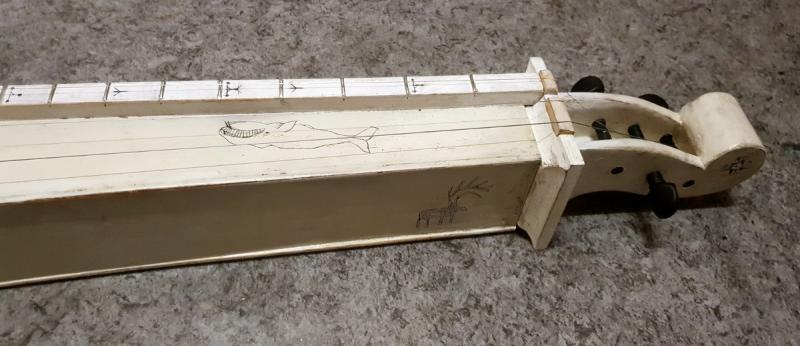
It's an imposing instrument and violin pegs would have looked silly on it.
I personally go smaller rather than larger in my selection of pegs, Nate. I like 1/2 size violin pegs on most of my builds. I've always felt like many of those pre-Revival dulcimers had 'way too large of pegs for the size of the tuning head and instrument. Probably, as you suggest, because the players had trouble adjusting hand whittled pegs with small heads and short shafts. With well fitting pegs, and experience, the issue is moot. People have been playing small violins since the 16th century.
My two Holly Leaf pattern dulcimers shown here have different size pegs. The larger one has full size -- 4/4 - violin pegs and the smaller one has either 3/4 or 1/2 violin pegs, I can't remember which. When I made that smaller scroll head, the full sized pegs just looked out of place -- too big for the size of the head, so I got smaller ones. The same taper reamer that I have works for all sizes of commercial pegs from 1/8 violin up to full size cello and viola IIRC.
Not a dumb question Nate. There is no apparent socio-cultural link between Hammered dulcimers (a kind of psaltery) and the Appalachian dulcimer(a kind of fretted zither). The only commonality is the shared "dulcimer" cognomen. The hammered dulcimer was a popular parlour instrument in the 1700s and 1800s across Europe and the Americas. It evolved from a Persian instrument dating back to the 900s which spread across Europe in the early medieval period. The Appalachian dulcimer evolved from fretted zither brought to the Pennsylvania colonies in the late 1600s/1700s by folks we today call the "Pennsylvania Dutch".
You asked "...why is there such a noticeable cultural overlap between hammered dulcimer people and mountain dulcimer people?". The answer, IMHO is that they are both, today, uncommon folk instruments (not guitars banjos or mandolins), and both -- as Dusty says, originally pure diatonic. As you suggest, I too suspect that the connection only came about during the mountain dulcimer and folk music Revival of the 50s and 60s.
Nate, it's not a dumb question at all, and I've wondered about it myself. The historical origins of the two instruments are completely different. The techniques of playing the two instruments are completely different. So what, other than the name, brings them together?
In terms of instrument design, both are types of zithers. So there's that.
But I think the more important similarity is that both are traditionally diatonic. Yes, MD players like myself have added extra frets to get chromatic notes, and many professional HD players play modern instruments with chromatic notes added as well. But traditionally, both instruments were mainly diatonic.
Nate, it's not a dumb question at all, and I've wondered about it myself. The historical origins of the two instruments are completely different. The techniques of playing the two instruments are completely different. So what, other than the name, brings them together?
In terms of instrument design, both are types of zithers. So there's that.
But I think the more important similarity is that both are traditionally diatonic. Yes, MD players like myself have added extra frets to get chromatic notes, and many professional HD players play modern instruments with chromatic notes added as well. But traditionally, both instruments were mainly diatonic.
Seems that Cello pegs or a good wrench are both way better options than making my own. Thanks
Nate
This question might be really dumb but I've been wondering this for years. What is the cultural link between hammered dulcimers and mountain dulcimers? To me the instruments couldn't possibly have much less in common. Their 'sweet sound' namesake seems to be the only thing. From what I have heard in the past, hammered dulcimers are hundreds of years older, and it's mostly a coincidence that mountain dulcimers are called the same name.So why is there such a noticeable cultural overlap between hammered dulcimer people and mountain dulcimer people? Shops that build both or sell both, MD groups with a HD player, or vice versa. Even here on this website are a bunch of pictures by MD builders of gorgeous hammered dulcimers they have built. I feel out of the loop haha.
Thanks
Nate